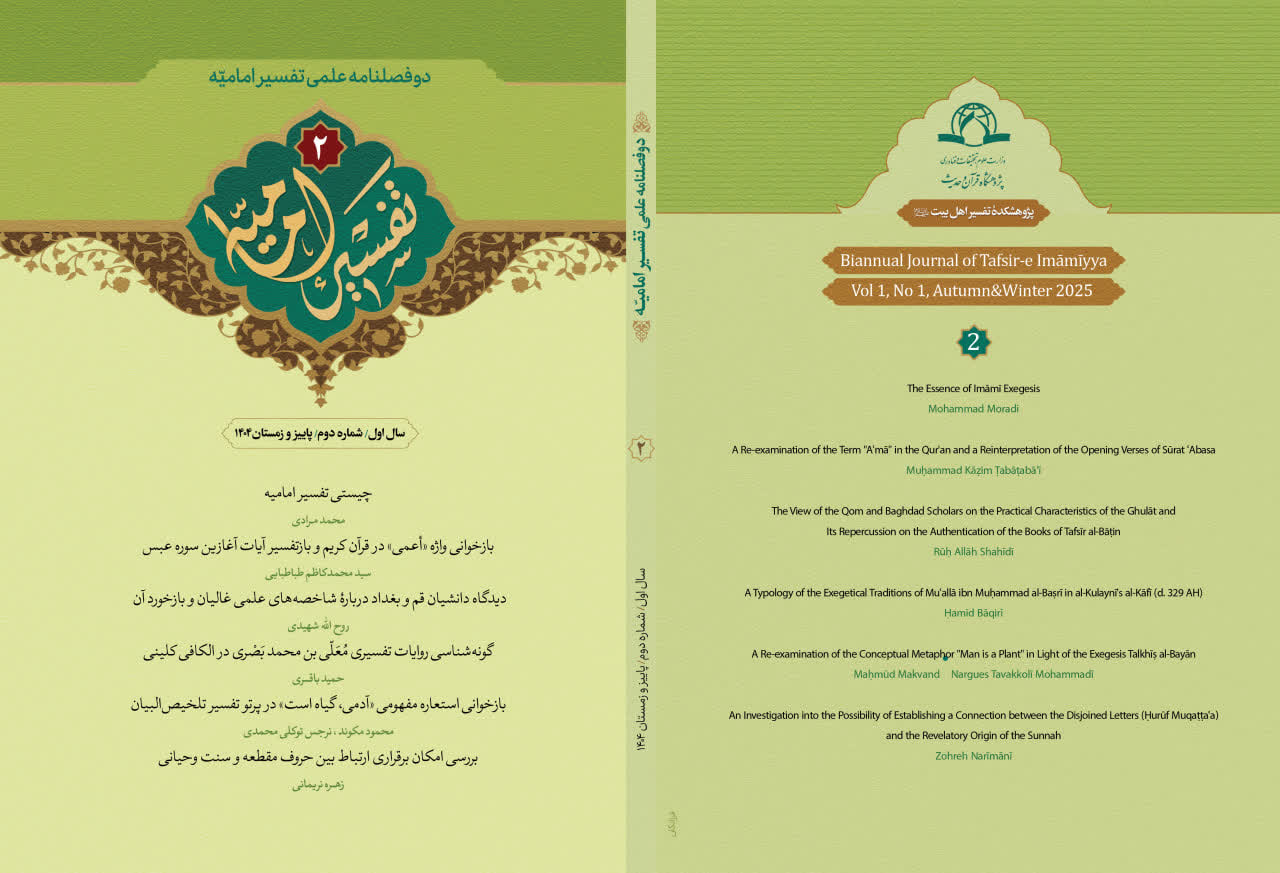
Exegesis (tafsir) is a process of uncovering meaning, and the discipline of Quranic exegesis bears the responsibility of discerning divine intent and purpose. Imamiyah exegesis is among the oldest, most dynamic, and deeply rooted traditions of Quranic interpretation in the Islamic world, with its origins tracing back to Imam Ali (peace be upon him). Subsequent Shi’a Imams further developed this exegetical tradition. Imamiyah scholars across different eras have been the custodians of this interpretive legacy, making immense efforts to preserve and promote it. Given its close connection to the heritage of the Ahl al-Bayt (peace be upon them), Imamiyah exegesis holds exceptional importance and necessity for achieving an accurate and correct understanding of the Quran.
The Journal of Imamiyah Exegesis, in line with Quranic and exegetical research, seeks to promote and expand such studies within the following key axes:
- Reconceptualizing the Nature (Concepts and Fundamentals) of Imamiyah Exegesis
- Sources of Imamiyah Exegesis
- Foundations and Methodology of Imamiyah Exegesis
- Imamiyah and the Hermeneutics (Ta’wil) of the Quran
- Trends in Imamiyah Exegesis
- History of Imamiyah Exegesis
- Thematic Studies in Imamiyah Exegesis
- Hadith Sciences (Fiqh al-Hadith) in Exegetical Narrations
- Orientalists and Imamiyah Exegesis
- New Exegetical Findings in Understanding the Verses of the Quran
- Novel Explanations of Quranic Verses
- Methodology of the Ahl al-Bayt’s (peace be upon them) Exegesis
- Quranic Sciences and Imamiyah Exegesis
- Pathologies and Challenges in Exegesis
- Comparative Study: Foundations, Methods, and Interpretations of Imamiyah vs. Other Perspectives
- Critique of the Foundations, Methods, Trends, and Interpretive Views in Imamiyah Exegesis
The Journal of Imamiyah Exegesis welcomes scholarly articles on the above themes and related fields.
🔶 Tel: +98 ۲۵ ۳۷۱۷۶۲۱۹ 🔶 Tel & Eita: +98 ۹۱۲۵۵۳۸۳۰۴
🔷 https://exegesis.riqh.ac.ir 🔶 P.O. Box. 37185 - 816
🔷 exegesis@riqh.ac.ir
Rereading the word "blind" in the Holy Quran and reinterpreting the opening verses of Surah Abs
Pages 33-48
seyed mohamad kazem tabatabaei
The views of scholars from Qom and Baghdad on the practical characteristics of Ghaliyan and its feedback on the validation of the books of "Tafsir al-Batin"
Pages 49-68
roohallah shahidi
Mu'alla ibn Muhammad al-Basri's Tafsir as a Source for al-Kulayni in Compiling al-Kafi: An Analytical Typology of its Narrations
Pages 69-96
hameid bagheri
Reinterpretation of the conceptual metaphor "Man is a plant" in the light of Takhis al-Bayan's commentary
Pages 97-119
Mahmood Makvand, نرجس tavakolimohamadi
Investigating the possibility of connection between cut letters and revealed tradition
Pages 120-152
zohreh narimani
Publication Information
Search
Keywords Cloud
- Methodology
- narrative interpretation
- Ahl al-Bayt
- Tafsir Al-Qummi
- Traditional Exegesis
- tafsir
- Virgin Mary
- ‘Atiyyah ‘ufi
- The school of Medina
- Hadith Exegesis
- ‘Atiyyah Ibn Sa’d
- Oral Quran
- Judaism
- Abrogation in the Quran
- Christianity
- symbolic vs. literal interpretation of Qur\'anic verses
- virtues of the Ahl al-Bayt (AS)
- Interpretation
- revelational origin
- an
- typology of Qurʾānic vocabulary
- Commentary of Tasnim
- Traditions concerning the Abrogation in the Quran
- Companions (Ṣaḥāba)
- the clear divine route
- Esoteric Exegesis
- pure theory
- Version of Imam ‘Ali (AS)
- The Book of Exegesis\"
- Imami Exegesis
- Mu\'tazili exegesis
- Version of Abu Bakr
- Hadith Quoted by Infallible Imam
- Religion
- Bibliography
- : Joseph (AS)
- misguidance
- Qur\'anic narratives
- Zurqani
- Tone
- Gharib al-Quran
- i Exegetical Trends
- the Early Shi`a Sources of Traditional Exegesis
- قرآن
- Quranic Lexicons (Single Words)
- Abs
- order of verses
- Muʿtazilites
- Content Support
- commentary on the basis of independent judgment
- Imami exegetes
- Ambiguous Verses
- Qom School of Exegesis
- Keywords: narrators\' generation (ṭabaqat al-ruwāt)
- Exegetical Traditions
- Abu Jarud’s Exegesis
- Shīʿī heritage
- استعاره
- : Ali Ibn Ibrahim Qummi
- Versions
- : Exegetical approach
- Explanation of Ambiguous Phrases
- Efficiency of Hadith for Interpretation
- validity
- the Book of “An Introduction to Islam for Jews”
- Doubts
- magic and sorcery
- Allameh Fazl Allah
- the Shi`a Recent Traditional Exegesis
- vision of jinn
- exegesis
- : Imami exegeses
- Reinforcement and Finding Source of Hadith
- infallible people
- core meaning
- : Islam
- Allameh Tabatabaei
- Qurʾān alteration and abrogation
- Western scholarship
- Validation of Exegetical Sources
- esoteric interpretation (Bāṭin & Ta’wīl)
- Yunis Ibn Abd Al-Rahman
- Interpretive narrations
- doubt
- Legitimacy
- : Reuven Firestone
- Imamites
- Tafsir al-Batin
- Ashʿarites
- philology
- Imamaites
- Keywords: spirit of meaning (Rūḥ al-Ma‘nā)
- culture
- Cut off letters
- Tafsir sources
- definite tradition
- violence
- blessing
- Exegetical Method
- Content Analysis
- Reading
- Qurʾānic vocabulary
- causality
- divine promises
- “Hamm”
- Interpretive Hadiths
- deterrence
- Keywords: Al-Qurbā
- thematic exegesis
- Qurʾānic interpretation
- Melody
- Characteristics of Shi&lsquo
- obscenity
- allegory
- Function of Relying on the Prophet’s Actions
- love for the Ahl al-Bayt (AS)
- Comparative Study
- Mushaf
- Abu Jarud
- Ibn al-Walid
- the Book. conceptual transformation
- Exaggeration
- Q 2:81
- order of chapters
- rayb
- : Interpretation of the Household of the Prophet (AS)
- Qom
- Mafatih al-Ghayb
- blindness
- anxiety
- Keywords: Majma‘ al-Bayān Exegesis
- Orientalism and the Quran
- Ma`ani al-Quran
- semantic extension
- Imamiah Interpretation
- Kitāb al-Tafsīr (\"
- Study of Approach
- گیاه
- falsification
- collection of verses
- function of Ijmā‘
- recompense
- Traditional Commentary
- Quran
- Naskh (Abrogation)
- study of heritage
- manuscripts
- Imamite scholars
- Shiʿi interpretation
- Typology of Narrations
- explanatory revelation
- Methodology of Interpretation
- consensus in exegesis
- Words of Quran
- )
- thorough examination of verses
- welfare
- History
- to renege
- Interpretive Traditions
- Shi\'a and Sunni exegeses
- unity of the path
- Singing
- the Night of Qadr
- Lost Commentaries
- Khaza`in al-Ghayb
- interpretation of the Qur\'
- Muhammad ibn Yaʿqūb al-Kulaynī
- رضی
- divine ways
- Comprehensive Traditional Commentary
- Commentary of Al-Mizan
- Aban bin Taghlab
- moderateness
- “lo la”
- Shi&lsquo
- Zaid Ibn Thabit
- existence of jinn
- kinship with Quraysh
- Muʿallā ibn Muḥammad al-Baṣrī
- Traditions of Collection of the Quran
- Zarb wa Daf`
- The Straight Path
- Writing the Quran
- i Interpretation
- Al- al-`Asma`
- niʿma
- Exegesis of the Quran
- certainty
- Qurʾānic identification
- history of exegesis
- تلخیص البیان
- Interpretive School of Kufa
- Typology of Hadiths
- Interpretation of Ahl al-Bayt (AS)
- Faḍl ibn Ḥasan al-Ṭabrisī
- Validity Check of Traditions
- Ahl al-Bayt centrality
- righteousness
- Weak Tradition
Related Journals
